Introduction
Bipolar Disorder (BD) is a chronic, recurrent mental illness characterized by episodes of mania, hypomania, and depression, which significantly affect patients’ psychosocial functioning and quality of life [1,2]. According to data from the World Health Organization, Bipolar Disorder is among the leading causes of disability in the adult population, with prevalence rates ranging from 1% to 3% in the general population [3].
Due to its complex clinical presentation and the risk of serious health consequences, including suicidal behavior, BD poses a significant challenge to healthcare systems [4]. Effective treatment requires an interdisciplinary approach involving pharmacotherapy, psychotherapy, and long-term nursing care [5]. Nurses, as members of the therapeutic team, play a key role in the care of patients with Bipolar Disorder in both inpatient and outpatient settings [6].
The primary responsibilities of nurses include monitoring patients’ mental status, observing adverse effects of mood-stabilizing medications, providing health education to patients and their families, and supporting adherence to therapeutic recommendations [7]. An adequate level of nurses’ knowledge regarding disease symptoms, treatment principles, and nursing interventions has a direct impact on patient safety and the effectiveness of therapy [8].
Research indicates that insufficient knowledge of mental disorders among healthcare personnel may lead to diagnostic delays, stigmatization of patients, and reduced quality of care [9,10]. In the context of Bipolar Disorder, the ability to recognize early signs of relapse and respond appropriately to changes in patient behavior is particularly important [11]. Therefore, assessing nurses’ knowledge of BD is an essential element in improving psychiatric care and planning educational activities.
The aim of the study was to assess the level of knowledge of nursing staff regarding Bipolar Disorder and to analyze the relationships between sociodemographic factors and the level of this knowledge.
Materials
The study involved 114 nurses. The inclusion criterion was employment as a nurse and consent to participate in the study. Participation was voluntary and anonymous. The study was conducted in 2025 in the Podkarpackie Voivodeship, Poland.
Methods
The research method used to investigate the study problem was a diagnostic survey. The research technique was a questionnaire, and the research tool was an original questionnaire consisting of 31 questions.
Statistical Analysis
Statistical analysis included the chi-square (χ2) test with Yates’ correction, the Fisher–Freeman– Halton test, and the chi-square goodness-of-fit test (used to assess differences in group sizes). The level of statistical significance was set at p < 0.05. Calculations were performed using IBM SPSS Statistics, version 22.
Results
A total of 114 nurses participated in the survey assessing knowledge of Bipolar Disorder. The majority of respondents were women (87.7%), while men accounted for 12.3%. Participants’ ages ranged from 21 to 60 years, with a mean age of 38.24 years. The average length of professional experience in the study group was 14.22 years, with a median of 10 years, indicating a varied level of professional experience among participants. A Master’s degree was held by 53.5% of respondents. The same proportion (53.5%) lived in urban areas, while the remaining respondents resided in rural areas.
Analysis of workplace showed that the largest group consisted of nurses working in the General Psychiatry Department (37.7%). In the General Surgery Department, 31.6% (n = 36) of respondents were employed. The remaining participants worked in the Ophthalmology Department (17.5%) and the Dermatology Department (13.2%).
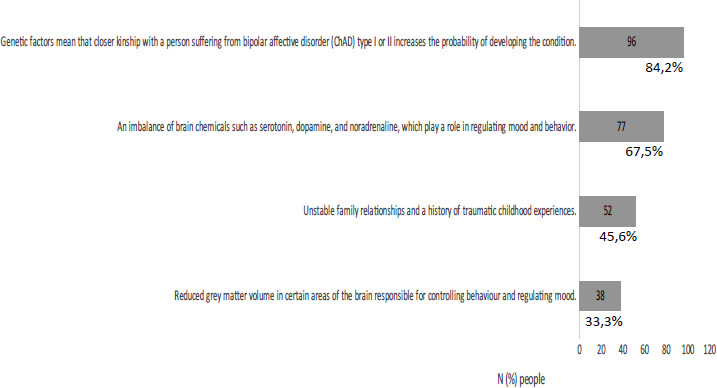
Nursing staff identified genetic factors as causes of Bipolar Disorder, indicating that close kinship with individuals diagnosed with BD type I or type II increases the risk of developing the disorder (84.2%, n = 96). Neurochemical imbalance involving substances such as serotonin, dopamine, and noradrenaline, which play a major role as neurotransmitters, was indicated by 67.5% (n = 77). Other significant determinants of BD, according to nurses, included unstable family relationships and traumatic experiences in childhood (45.6%, n = 52), as well as reduced gray matter volume in certain brain areas responsible for behavioral control and emotional regulation (including the temporal and frontal lobes) (33.3%, n = 38) (Figure 1).
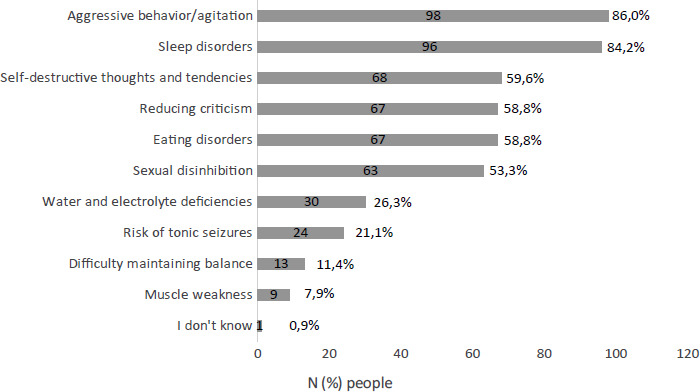
The most frequently reported nursing problems that may occur during the care of patients with Bipolar Disorder included aggressive behavior or psychomotor agitation (86.0%), sleep disturbances (84.2%), suicidal thoughts and tendencies (59.6%), reduced critical judgment (58.8%), appetite disturbances (58.8%), and sexual disinhibition (55.3%) (Figure 2).
According to nursing staff, the main goals of nursing care during periods of severe depression included ensuring an individual therapeutic relationship with members of the therapeutic team and striving to develop the patient’s ability to establish and maintain relationships with team members (84.2%), providing comfortable conditions, silence, calmness, and a sense of safety (79.8%), offering verbal support, active listening, maintaining eye contact, not interrupting, paraphrasing statements, and sharing the communication process (78.1%), as well as supporting voluntary participation in group activities and appropriate social behavior (76.3%).
In the case of manic episodes, nurses identified the goals of nursing care as establishing verbal contact with the patient, using concise communication, setting clear rules and boundaries, attentive listening to determine the patient’s needs and well-being (90.4%), ensuring safety and psychological comfort for staff, the patient, and other patients (83.3%), and implementing pharmacotherapy in accordance with medical orders, particularly antipsychotic treatment (78.9%).
Analysis of the overall level of knowledge about Bipolar Disorder showed that 34.2% of respondents achieved a satisfactory result (≥75% correct answers), while 65.8% demonstrated an unsatisfactory level. This indicates that insufficient general knowledge predominated in the study group. The difference was statistically significant (χ2(1) = 11.368; p = 0.0007). Comparison of overall knowledge level with sociodemographic characteristics showed that age did not significantly differentiate results. Respondents aged up to 40 years more often achieved a satisfactory level of knowledge compared with older participants; however, this difference did not reach statistical significance. Gender also did not affect the level of general knowledge, with similar proportions of satisfactory results in both groups.
A significant relationship was observed for work experience: nurses with up to 10 years of professional experience significantly more often achieved a satisfactory level of general knowledge than those with longer experience. Level of education and place of residence did not significantly differentiate knowledge levels despite observed percentage differences between categories (Table 1).
Table 1
Overall level of knowledge about Bipolar Disorder (BD) (≥75% correct answers) by sociodemographic characteristics (N = 114)
A comprehensive analysis of statistical significance values for individual knowledge domains confirmed that most sociodemographic factors, such as age, gender, education, and place of residence, were not significantly associated with knowledge levels in the analyzed areas. In the case of general knowledge, work experience and workplace were significant factors, whereas in all specific knowledge domains (basic scope of the disorder, symptoms, treatment, and goals of nursing care), workplace was the only factor that significantly differentiated knowledge levels (Table 2).
Table 2
Associations between sociodemographic factors and levels of knowledge about Bipolar Disorder (BD) across specific knowledge domains (p-values)
Discussion
Bipolar Disorder is a condition that most commonly affects young individuals before the age of 35. The main characteristic of the disorder is the alternating occurrence of manic and depressive symptoms. BD has a chronic course, and prognosis is most often determined by early diagnosis and the implementation of appropriate treatment. Bipolar Disorder is often considered not as a single disease entity but as a syndrome of symptoms that occur alternately. Recurrent mood disturbances, including depression, mania, and hypomania, are characteristic features. Due to the chronic nature of the disorder, treatment is long-term and lifelong, most commonly involving psychotherapy, psychoeducation, and pharmacological treatment.
Nursing staff, particularly those working in psychiatric wards, provide care for patients with Bipolar Disorder as part of their professional duties. Nurses are expected to possess extensive knowledge of BD due to the need to provide comprehensive care, identify patient problems, understand applied treatments, and recognize behavioral changes. Knowledge of Bipolar Disorder enables early recognition of symptoms, proper care planning, and the implementation of multilevel treatment strategies. Continuous education and professional development are therefore expected of nursing staff to ensure comprehensive patient care.
The authors’ own research conducted among nursing staff indicates that the level of knowledge regarding Bipolar Disorder is unsatisfactory. Öksüz et al. conducted qualitative research among 15 nurses caring for patients with mental disorders in Türkiye. They observed that nurses encountered many difficulties in care, particularly in setting boundaries in patient interactions, managing patients’ demands, and selecting appropriate communication strategies. Analysis of their findings showed that nurses experienced difficulties in caring for manic patients due to insufficient knowledge. The authors emphasized the need for training to improve communication skills and effective fulfillment of patients’ needs [12]. Musafiri et al. conducted a study among 246 nurses regarding mental disorders in the Western Cape Province of South Africa. They found that the level of knowledge among the surveyed nurses was moderate, indicating an insufficient level of knowledge [13]. Weare et al. conducted research among nurses in Australia and noted that only half of respondents demonstrated an adequate level of knowledge regarding mental disorders [14]. Sahile et al. conducted research among nurses working in primary healthcare settings and showed that 60.3% of respondents had sufficient knowledge of psychiatric disorders; however, this result was associated with lowering the threshold score used to assess knowledge [15]. Other studies demonstrated that approximately half of respondents had a good level of knowledge regarding mental disorders [16]. Todorova et al. conducted research among emergency medical nurses and found that their level of knowledge regarding mental disorders was moderate. Interestingly, while nurses possessed basic knowledge of mental disorders, their knowledge regarding care provision for patients with mental illnesses was insufficient [17].
The authors’ own findings indicated that nursing staff working in the General Psychiatry Department had a higher level of knowledge regarding Bipolar Disorder. Respondents correctly identified genetic and individual/environmental factors as determinants of BD, with biological factors playing a lesser role. Gerace et al., in studies conducted in Australia, noted that education level significantly influenced nurses’ knowledge of mental disorders. Their findings showed that nursing assistants had a lower level of knowledge regarding mental disorders compared with registered nurses [18]. Rayan et al. conducted research among nurses working in psychiatric wards in Jordan, assessing attitudes toward individuals with mental disorders. They observed that stigma toward mental illness was associated with gender, workplace, marital status, age, and knowledge of mental disorders, highlighting the need for training programs aimed at increasing awareness and reducing stigma related to mental illness [19].
The authors’ own research also showed that nursing staff in the General Psychiatry Department had a higher level of knowledge regarding the symptoms of Bipolar Disorder. Respondents identified extreme mood swings and changes in behavior, energy, and thought patterns as typical symptoms, with characteristic features including severe depressive and manic episodes (at least one manic episode during a lifetime). Kolb et al. conducted comparative studies in Taiwan and the United States among nurses working in psychiatric hospitals and those employed in other departments. Their analysis showed that nurses who routinely cared for patients with mental disorders had greater knowledge of symptoms and management of patients experiencing acute psychosis [20]. Sahile et al. conducted research in Ethiopia; however, their results were unsatisfactory due to the low level of nurses’ knowledge regarding symptoms of common mental disorders. Only one-third of nurses demonstrated good knowledge in this area [15].
Analysis of the authors’ own research showed that nursing staff in the General Psychiatry Department had a higher level of knowledge regarding the treatment of Bipolar Disorder. Nurses emphasized that BD treatment involves multiple therapeutic techniques, including pharmacotherapy, psychotherapy, cognitive-behavioral therapy, social rhythm therapy, interpersonal therapy, psychoeducation, and family therapy. Musafiri et al. demonstrated that most surveyed nurses correctly identified symptoms, general characteristics, and treatment of major mental disorders in South Africa, including depression, anxiety disorders, Bipolar Disorder, schizophrenia, and substance use disorders [13]. Begum et al. conducted research among mental health nurses in England regarding knowledge of antipsychotic medication side effects. They noted that 75% of patients reported side effects of pharmacological treatment, which, if incorrectly recognized, could negatively affect the care process. Their findings showed that nurses’ knowledge was insufficient and could negatively impact patient health [21]. Bressington et al. reported that nurses expressed concerns regarding discussions of psychiatric treatment methods [22].
The authors’ own research highlighted that nursing staff in the General Psychiatry Department had a higher level of knowledge regarding appropriate formulation of nursing care goals for patients with Bipolar Disorder. An interesting analysis was presented by Fradelos et al., who examined nursing tasks in the care of patients with Bipolar Disorder. Their study involved 10 nurses and emphasized the important role of nursing care, particularly during periods of symptom exacerbation. Nursing interventions were found to be essential in managing emotions, thoughts, and behaviors of patients experiencing acute mania [23].
The results of the authors’ own study are unsatisfactory due to the low level of knowledge regarding Bipolar Disorder. However, nursing staff in the General Psychiatry Department demonstrated slightly higher knowledge regarding symptoms, treatment, and formulation of nursing care goals. There is a limited number of studies assessing nurses’ knowledge of Bipolar Disorder, which indicates the need for further research and educational initiatives in this area.
Conclusions
The knowledge of nursing staff regarding Bipolar Disorder requires systematic improvement, particularly to ensure safe, effective, and comprehensive care for patients with mood disorders.
The workplace environment plays a key role in shaping nursing competencies in psychiatric care, emphasizing the importance of clinical experience and daily contact with patients with mental disorders in building practical knowledge.
The study results indicate the need to strengthen nursing education in mental health at all stages of training and professional development, regardless of specialization or workplace.
Implications for nursing practice
The study findings highlight the need to implement regular training and educational programs on mental disorders, with particular emphasis on Bipolar Disorder, for nursing staff across all specialties. It is essential to include topics related to recognizing symptoms of mania and depression, crisis management, and monitoring adverse effects of pharmacotherapy in continuing professional development. Promoting interdisciplinary collaboration and enabling the exchange of experiences between psychiatric nursing staff and nurses working in other units may contribute to improving the quality of care for patients with BD. Nursing practice should also emphasize the nurse’s role in educating patients and their families, particularly regarding early recognition of relapse symptoms and the importance of adherence to therapeutic recommendations. The results may serve as a basis for developing nursing care standards and procedures for patients with Bipolar Disorder, potentially improving patient safety and the effectiveness of interventions.