Introduction
Pain is one of the most frequently reported health complaints in the working population and represents a significant public health challenge. Chronic pain is associated with reduced quality of life, impaired work capacity, increased sickness-related absenteeism, and a higher risk of early withdrawal from employment [1]. Nurses constitute a particularly vulnerable occupational group, as their work involves substantial physical demands, tasks performed in constrained postures, manual repositioning of patients, and considerable psychosocial stress [2,3].
Studies across European countries indicate that musculoskeletal pain affects 60–80% of nurses [4]. The musculoskeletal pain is recognised as a leading cause of sickness-related absenteeism [5], reduced productivity, and attrition from the nursing profession [6]. Research highlights a growing problem of pain among nurses working extended shifts, facing staff shortages, and having limited opportunities for recovery [7].
The studies indicate that low physical activity, insufficient rest, and maladaptive stress-coping strategies significantly increase the risk of pain disorders in nurses [8]. In the United States, nurses who engage in regular physical activity report less chronic spinal pain and lower pain intensity [9]. Sleep is another critical component of health behaviours. Sleep disturbances, common among nurses working shifts and extended hours, are associated with increased pain severity, reduced pain threshold, and a higher risk of chronic pain [10]. Research further suggests that sleep deficiency predisposes individuals to maladaptive compensatory behaviors and impairs stress-coping capacity, potentially contributing to the persistence of pain complaints [9,10].
Despite their high level of medical knowledge, nurses often fail to follow recommendations for a healthy lifestyle [11]; for example, many do not engage in regular physical exercise due to work-related fatigue, lack of time, and family responsibilities [10]. This phenomenon is largely attributable to organisational factors, including work overload, time pressure, shift work, and limited access to health promotion programs targeting healthcare personnel [12–14]. From a public health perspective, this issue is particularly important, as deterioration in nurses’ health may affect not only their well-being but also the quality and safety of patient care [9,10].
Although numerous studies have examined the prevalence of pain among nurses, relatively few have explored its association with health behaviours. Understanding these relationships may provide a foundation for developing effective preventive interventions and health promotion strategies in the nursing work environment. Therefore, the aim of this study was to evaluate the association between health behaviours and the occurrence of pain among employed nurses.
Materials and methods
The study was conducted as a cross-sectional survey. It was carried out in accordance with the principles of the Declaration of Helsinki. Participation was voluntary and anonymous, and all respondents provided informed consent prior to enrollment. The study was determined not to constitute a medical experiment, as confirmed by the Bioethics Committee at Karol Marcinkowski University of Medical Sciences in Poznań (KB-827/23).
Study population
The study had a cross-sectional design and was conducted in the Podkarpackie Voivodeship, Poland. It included nurses working across various healthcare settings in the region, including hospitals, primary care clinics, sanatoria, nurseries, and long-term care facilities. Given the previously reported influence of sex on HBI scores [11] and the predominance of women in the nursing profession, only female nurses were included in the present analysis.
Research tools
Standardised research tools were used to assess pain and health behaviors. Pain characteristics were evaluated using the Laitinen Pain Scale [15], while health behaviours were assessed with Juczyński’s Health Behavior Inventory (HBI) [16]. These tools were supplemented by an author-designed questionnaire collecting sociodemographic data and information on participants’ workplace and duration of employment.
The Laitinen Scale enables subjective assessment of pain across four factors; each rated on a five-point scale from 0 to 4. The factors assess:
pain intensity (ranging from without pain to not sustainable pain),
pain frequency (ranging from does not occur to continuous pain),
painkillers’ intake (ranging from without medication to permanently– very big doses), and
motor activity limitation (ranging from none to preventing self-sufficiency).
Juczyński’s Health Behavior Inventory is designed to assess health-promoting behaviours across four domains: proper eating habits, preventive behaviours, positive mental attitude and health practices.
The questionnaire comprises 24 items, with six items per domain. The frequency of engagement in each behaviour is rated on a five-point scale (from 1 to 5). Total scores range from 24 to 120, with higher scores indicating greater engagement in health-promoting behaviours. The overall score, after conversion to standardised units, was interpreted according to the sten norms provided by Juczyński [16], with scores corresponding to stens 1–4 classified as low, 5–6 as average, and 7–10 as high.
Statistical analysis
Quantitative data are presented as means and standard deviations. Given that the distribution of certain variables deviated from normality, as assessed by the Shapiro-Wilk test, medians and interquartile ranges (IR: Q1–Q3), encompassing the central 50% of observations, are additionally reported. Qualitative variables are presented as the number of participants meeting the defined criterion (percentage).
Associations between quantitative variables were analysed using the Kruskal–Walli’s test with post hoc Dunn’s test, whilst qualitative variables were examined using the Chi-square (χ2) test. HBI scores were defined as the dependent variable, with age, educational level, workplace, duration of employment, additional employment, nursing specialisation and scores for the four factors of the Laitinen Pain Scale as independent variables. A p-value of less than 0.05 was considered statistically significant.
Results
The mean age of the 429 nurses included in the study was 44.8 ± 12.5 years (median 47.0; IQR 35.0–55.0), and the mean duration of employment was 19.9 ± 12.9 years (median 20.0; IQR 8.0–30.0). Secondary nursing education was reported by 83 participants (19.3%), a bachelor’s degree by 181 (42.2%), and a master’s degree by 165 (38.5%). Among the participants, 241 nurses (56.2%) declared being a specialist, with the most common being surgical nursing (n = 75; 31.1% of nurses with a specialisation) and internal medicine nursing (n = 74; 30.7%).
The largest proportion of participants were employed in hospital settings (n = 294; 68.5%), while approximately one in five worked in outpatient clinics (n = 86; 20.1%). Of the remainder, most were employed in long-term care facilities (n = 37; 8.6%). Nearly half of the nurses in the sample reported holding additional employment (n = 193; 45.0%).
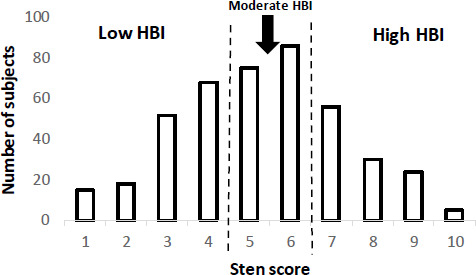
The mean HBI score was 82.4 ± 14.5 (median 83.0; IQR 72.5–93.0), indicating an average level of health behaviours. The distribution of participants across sten scores is shown in Figure 1. Low health behavior scores (stens 1–4) were observed in 153 nurses (35.8%), average scores (stens 5–6) in 163 (38.0%), and high scores (stens 7–10) in 113 (26.3%).
Figure 1
Number of nurses analysed (n = 429) assigned to each sten score based on Juczyński’s Health Behavior Inventory (HBI).
Pain characteristics in employed nurses
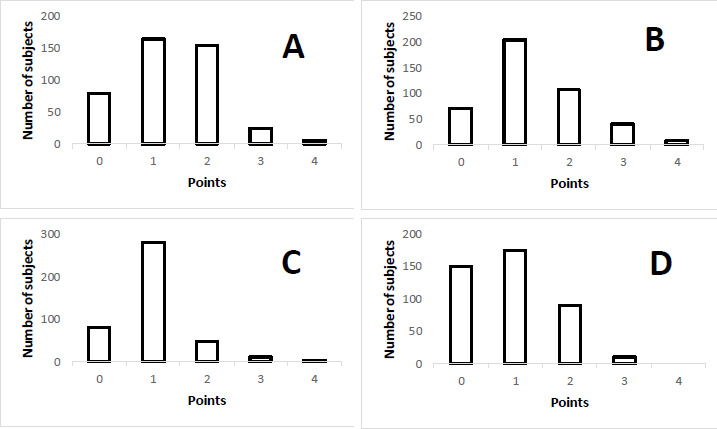
Regarding Factor 1 (pain intensity), 80 nurses (18.6%) reported no pain (score 0), whereas 26 (6.1%) reported very strong pain (score 3) and 3 (0.7%) reported not sustainable pain (score 4). For pain frequency (Factor 2), 72 nurses (16.8%) reported no pain occurrence (score 0). The most frequently selected response was 1, indicating periodical pain (n = 205; 47.8%), while 38 nurses (8.9%) reported very frequent pain (score 3) and 8 (1.9%) continuous pain (score 4). Concerning painkillers’ intake (Factor 3), 80 nurses (18.6%) reported no use of pain medication (score 0), with the most common response being 1, indicating periodical usage (n = 283; 66.0%). For motor activity limitation attributable to pain (Factor 4), the largest proportion of nurses reported partial limitations (score 1; n = 176; 41.0%), whereas 90 (21.0%) reported limitations making work difficult (score 2), and 11 (2.6%) reported limitations making work impossible (score 3). Detailed data are presented in Figure 2.
Figure 2
Laitinen Pain Scale factor scores among analysed nurses (n = 429): A – pain intensity, B – pain frequency, C – painkillers’ intake, D – motor activity limitation.
The mean scores for Factors 1 and 2 of the Laitinen Pain Scale (1.3 ± 0.9; median 1.0 [IQR 1.0–2.0] for both) were significantly higher than those for Factors 3 and 4 (1.0 ± 0.7; median 1.0 [IQR 1.0–1.0] and 0.9 ± 0.8; median 1.0 [IQR 0.0–1.0], respectively; p < 0.001 for all comparisons).
Following stratification of nurses into three groups according to Juczyński’s Health Behaviour Inventory (HBI), those with low and high HBI scores differed significantly across all Laitinen Pain Scale factors. Participants with higher HBI scores reported lower pain-related scores (p<0.01 for Factors 1 and 3; p<0.001 for Factors 2 and 4). Detailed comparative results for all parameters across the groups are presented in Table 1.
Table 1
Characteristics of the studied nurses (n = 429), with groups distinguished according to their scores on Juczyński’s Health Behavior Inventory (HBI): Group 1 – low HBI scores [sten 1–4], Group 2 – average HBI scores [sten 5–6], Group 3 – high HBI scores [sten 7–10]. Continuous variables are presented as mean ± SD (median; interquartile range Q1–Q3), and ordinal variables as the number of participants meeting the criterion (percentage).
Discussion
The results of the present study indicate that pain represents a prevalent and multidimensional health problem among employed nurses. Both European and American studies report the prevalence of musculoskeletal pain in this occupational group at over 75% [1,4]. The most common pain complaints are chronic in nature and adversely affect work capacity and the quality of patient care [6]. The findings of the present study align with this trend, showing a high proportion of positive responses across all Laitinen Pain Scale Factors, thereby confirming that pain is not an incidental phenomenon but rather a frequent and significant health issue in this professional group. In the study sample, over 80% of participants reported experiencing pain.
Epidemiological and prospective studies have demonstrated associations between spinal pain and reduced occupational capacity among employed nurses [10]. Similarly, research conducted among Asian nurses has shown that even moderate pain complaints can have tangible consequences for work performance and daily functioning [17]. The present findings are consistent with these observations, with approximately 25% of participants reporting limitations that affected their ability to perform professional duties.
The analysis of results revealed that the mean HBI score corresponded to an average level of health behaviours; nevertheless, low health behaviour scores were observed in over one-third of participants. The health behaviours of employed nurses have been characterised in detail in our previously published study [11]. The age of study participants (median 47 years) and the duration of employment (median 20 years) underscore the need to interpret these findings in the context of prolonged occupational exposure. Many years of professional activity under conditions of high physical and psychosocial demands may lead to a gradual depletion of the body’s adaptive resources, potentially resulting in the accumulation of recovery deficits. This association is further supported by research indicating that age moderates the relationship between stress and occupational burnout, with older nurses more frequently experiencing heightened emotional exhaustion and reduced resilience to work-related demands [18]. An additional important consideration is that nearly half of the respondents in the present study reported holding supplementary employment, which may further limit opportunities for rest and recovery.
From the perspective of health behaviours, it should be emphasised that limited recovery capacity may indirectly reduce the frequency of engagement in health-promoting activities. Research indicates that, despite its well-documented importance for maintaining functional capacity and overall psychophysical well-being, physical activity is one of the least frequently practised components of lifestyle among nurses, a phenomenon linked, among other factors, to occupational demands and challenges in achieving an adequate work–recovery balance [8,13].
Given these findings, the phenomena observed in the study sample may be considered multifactorial, arising from the combined effects of prolonged professional experience, high occupational demands, and potentially limited recovery capacity. Furthermore, the level of health behaviours may act as a moderating factor in the relationship between occupational burden and health status, as supported by research showing an association between higher engagement in health-promoting behaviours and more favourable self-assessed physical and psychological health [13].
In the present study, the level of health behaviours was the only variable among those analysed that differentiated pain frequency and intensity, analgesic use, and functional limitations. This suggests that health behaviours may influence both the dynamics and perpetuation of pain complaints and their impact on daily functioning. The literature highlights the role of psychosocial factors and lifestyle in modulating the course of chronic pain [19]. Consequently, the observed association between health behaviour level and pain frequency and functional consequences indicates that a health-promoting behaviour profile may act as a modifying factor in pain disorders, a finding supported by previous research [8].
Of particular importance are elements within the domain of health practices, including sleep, recovery, and physical activity [11,21]. Deficits in these areas predispose individuals to the persistence of pain complaints, as confirmed by studies involving healthcare personnel and the nursing workforce [9]. According to the contemporary biopsychosocial model, biological processes, psychological state, and social context are closely integrated and jointly determine the course of pain disorders [21]. Nurses are a professional group at high risk of pain disorders due to the accumulation of physical and organisational stressors [11]. Insufficient recovery under conditions of repetitive occupational demands may lead to persistent muscular tension and increase the likelihood of chronic pain complaints, as demonstrated in studies of nursing staff [8]. In light of the foregoing, lower levels of health behaviours may be associated with reduced adaptive capacity in response to occupational demands. It should be emphasised, however, that the cross-sectional design of the study precludes determination of causality; it is unclear whether low levels of health behaviours increase the risk of persistent pain or, conversely, whether chronic pain leads to reduced physical activity, impaired sleep quality, and a decline in health-promoting behaviours. The bidirectional nature of this relationship, as discussed in the literature, remains a plausible explanation [19].
As health behaviours are potentially modifiable factors, our findings have important implications for designing preventive interventions aimed at reducing the occurrence of pain complaints and their consequences within the nursing work environment. From a public health perspective, they support the rationale for implementing preventive programmes that strengthen health behaviours in the nursing workplace.
Conclusions
Pain is a common problem among employed nurses.
Low levels of health behaviours were associated with higher pain frequency and intensity, as well as more frequent analgesic use and greater functional limitations.
As a modifiable factor, health behaviours should be a central focus of preventive strategies in the nursing workplace.